You get the email in August. The subject line says something like “2026–2027 Academic Calendar Now Available,” and there’s a PDF attached. You open it, glance at a page packed with color-coded boxes, abbreviations you don’t recognize, and dates listed in tiny font — and then you close it, tell yourself you’ll figure it out later, and promptly forget about it until the morning your kid reminds you at 7 a.m. that today is a half day.
Sound familiar? You’re not alone.
School district calendars are packed with useful information, but they’re designed by administrators for administrators — not for busy parents trying to plan childcare, book a family vacation, or simply figure out whether school is open on a random Friday in October. Once you know what you’re actually looking at, though, these documents become one of the most practical planning tools you have all year.
This guide walks you through every section of a typical US public school district calendar, what each piece means, and exactly how to use it.
Why Every District Calendar Looks a Little Different
Before diving in, it helps to understand why your district’s calendar might look different from your neighbor’s district — even if they’re just one county over.
Thirty-one states plus the District of Columbia require at least 180 days of instruction, but each state defines instructional time differently, and many allow local school districts to determine their own specific requirements. That flexibility is why a district in Texas might start school in early August while a district in Michigan doesn’t start until after Labor Day, and why spring break falls on different weeks across different counties in the same state.
Generally, the standard requirement is a minimum equivalent of 180 days of instruction at 4 to 6.5 hours per day — but the specifics vary significantly by state law.
The bottom line: always use your specific district’s calendar, not a neighboring district’s, and certainly not a generic template you find on a random website.
The School Year Start and End Dates
This is the first thing most parents look for, and it’s usually the most prominently displayed on the calendar — either at the top of the page or in a summary box.
The first day of school for students is often a full instructional day, though some districts ease in with a half day or a grade-staggered start (where, for example, only incoming kindergartners attend on day one). The last day of school is similarly important — and it’s worth noting that the published last day is often contingent on no emergency closures happening during the year, which brings us to makeup days (more on that shortly).
When you find these dates, add them to your phone calendar immediately. These are the anchors around which everything else — summer camp registration, family travel, end-of-year celebrations — gets organized.
Holidays and Scheduled Breaks
This section is where most of the family planning happens, and it’s usually the most straightforward part of the calendar once you know what you’re looking at.
Typical holidays and breaks you’ll see on a US public school district calendar include:
Labor Day — Schools are almost universally closed. If your district starts before Labor Day, this is often the first school holiday of the year.
Thanksgiving Break — Most districts close for Thanksgiving recess running from the Wednesday before through the Friday after, though the exact window varies by district.
Winter Break — Typically the longest break of the year outside of summer. Winter break commonly runs from just before Christmas through the first few days of January, with school resuming in early January.
Martin Luther King Jr. Day — A federal holiday observed by virtually all public school districts, falling on the third Monday of January.
Presidents’ Day / Mid-Winter Break — Some districts take only Presidents’ Day off; others, particularly in the Northeast and Pacific Northwest, schedule a full mid-winter break week in February. Mid-winter break, when observed, typically falls around the third week of February.
Spring Break — Usually one week in March or April. Spring recess for many districts falls in early-to-mid April, though exact timing varies significantly by district and state.
Memorial Day — A federal holiday; schools are closed.
Important tip: When you see a break labeled “recess” versus “holiday,” the distinction matters. A holiday means only that specific day is off. A recess means the entire period — sometimes a full week — has no school. Read carefully.
See also: 2026-2027 School Calendars
Teacher Workdays, Professional Development Days, and Institute Days
This is the section that catches the most parents off guard, because these are school days where the building is open, and staff are working — but students are not there.
These days go by different names depending on the state:
- Teacher Workdays (common in the South and Mid-Atlantic)
- Professional Development Days or PD Days (common nationally)
- Institute Days or Teacher Institute Days (common in Illinois)
- Planning Days or Preparation Days
In Illinois, for example, Teacher Institute Days — capped at a maximum of four — do not count toward the 176-day student attendance requirement and are not student attendance days. They exist so teachers can attend training, collaborate on curriculum, visit other schools, or participate in district-wide professional learning.
From a parent’s perspective, these days are no different from a school holiday: your child is home, and you need childcare or supervision coverage. The key is finding them on the calendar, because they are often scattered throughout the year rather than clustered around obvious breaks. A random Thursday in September might be a PD day. So might the Friday before a long weekend.
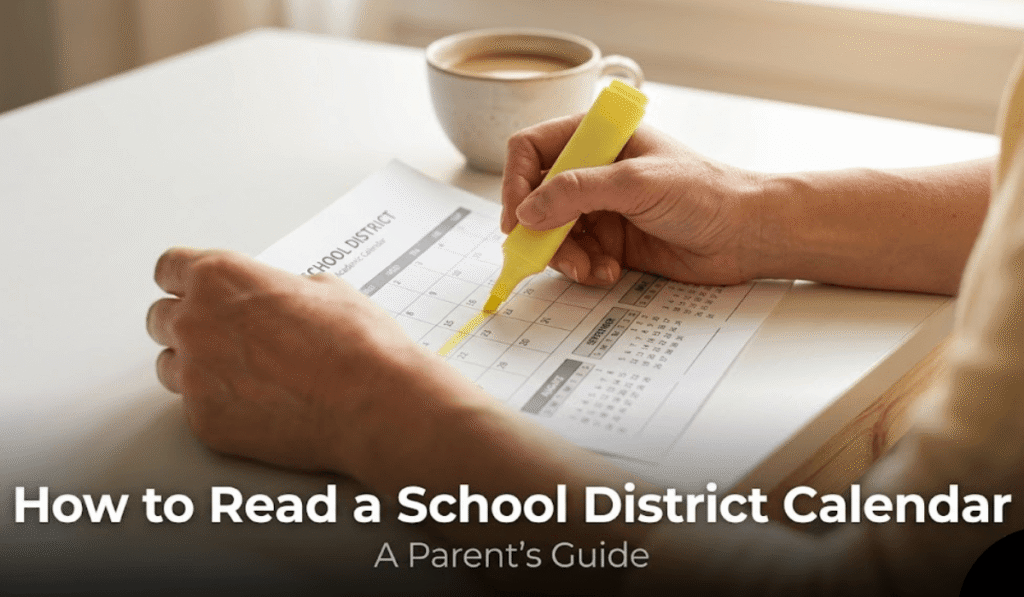
How to spot them: On most district calendars, these days are color-coded differently from student instructional days or holidays. Look for the legend at the bottom or side of the calendar page — it will tell you what each color or symbol means.
Early Release and Late Start Days
These are partial days — either students are dismissed earlier than the normal dismissal time, or school starts later than usual. They’re easy to miss and can create real logistical headaches if you’re not prepared.
Early release days are built into the calendar to give teachers time for collaboration, grading, or professional development during the school year without using a full day. Early release days provide time for teacher training and collaboration while keeping students in school for at least part of the day.
On some district calendars, these are listed by exact dismissal time (“Early Release — 1:00 PM dismissal”). On others, they’re marked with a symbol or abbreviation. Check your district calendar’s legend for the notation used.
If your child takes a school bus, uses after-school care, or you pick them up — an early release day changes every single part of that routine. Mark these dates carefully.
Grading Periods, Quarter Ends, and Report Card Dates
Most US public school districts divide the academic year into either quarters (four grading periods) or semesters (two grading periods), sometimes with trimesters in elementary schools.
District calendars typically include the end dates for each quarter, along with the scheduled dates for progress report distribution and parent-teacher conferences tied to those reporting periods.
Here’s what to look for:
- End of Quarter/Semester: The last instructional day of each grading period. Grades are finalized after this date.
- Progress Report Distribution Dates: Midpoint check-ins between report cards — usually sent home or posted online 4–6 weeks into each grading period.
- Report Card Distribution Dates: The date official grades are released. In many districts this is now online, but the calendar will still list the official release date.
These dates matter beyond just knowing when to check your child’s grades. Quarter endings often coincide with changes in class schedules (especially in high school), athletic eligibility reviews, and eligibility for extracurricular activities.
Parent-Teacher Conference Days
Parent-teacher conference days are typically non-attendance days for students, scheduled after the end of the first and third quarters, where parents and guardians pick up report cards and meet with teachers.
While district-wide conference dates are published on the main calendar, individual teachers may work with families to schedule their specific conference time separately.
Note that in some districts — particularly large urban ones — conference scheduling is done at the school level, so the district calendar gives you the date but your child’s teacher or school office confirms the specific time slot.
Emergency/Makeup Days
At the back of most district calendars, or noted in the calendar guidelines, you’ll find a list of emergency makeup days — days that are reserved in case school needs to be closed unexpectedly due to weather, a public health issue, or another emergency.
District calendars are typically required to include a minimum number of proposed emergency days — these days are built into the calendar in advance but removed on the final submitted calendar if they are not needed.
In practice, this means: if your district uses snow days, those missed days are made up using the pre-designated makeup days — which are often days that were previously scheduled as breaks. A day that showed as a holiday in October could become a school day in June if the district used too many emergency closures.
Always check at the end of the school year whether any makeup days were activated. It can affect your summer planning.
How to Use Your District Calendar Like a Pro
Once you understand what you’re looking at, here’s a practical approach to getting maximum value from the document:
Download the PDF and save it. Don’t just bookmark the page — download the official PDF directly from your district’s website and save it somewhere you can access offline.
Add every no-school day to your phone calendar right now. Don’t wait. Do it the day the calendar is released in spring or summer. Include teacher workdays, early release days, and emergency makeup days.
Check the legend every time. Color codes and abbreviations vary by district. The legend is the key to reading everything correctly.
Verify before booking travel. Before you book flights, hotels, or camps around school breaks, confirm the exact dates on the official district calendar. Spring break dates in particular can shift year to year.
Re-check mid-year. Districts do amend calendars during the school year. Parents should sign up for school messaging systems, as many districts use automated alerts for closures, emergency updates, and calendar changes. When an amendment is announced, compare it against your personal calendar and update accordingly.
FAQ
Q1: What is the difference between a teacher workday and a school holiday?
A school holiday is a day off for both students and staff — no one is at school. A teacher workday (also called a Professional Development Day or PD Day) is a day when teachers and staff report to school for training, planning, or meetings, but students do not attend. From a parent’s perspective the result is the same — your child is home — but the reason is different. Teacher workdays are scattered throughout the year, so always check your district calendar’s legend carefully so you don’t confuse them with regular holidays.
Q2: How many days are in a typical US public school year?
Most US public school districts follow a 180-day school year for students, which is the minimum required by the majority of states. However, the exact number varies by state — some states require as few as 160 student contact days while others mandate 185 days or more. The total school year calendar, including teacher workdays and professional development days, typically spans around 190 to 200 calendar days from the first day staff report to the last day of school.
Q3: What happens to school breaks if snow days or emergency closures are used?
Most districts build emergency makeup days into their calendar at the start of the year — these are days reserved specifically to replace any school days lost to weather, public health emergencies, or other unexpected closures. If your district uses snow days, those missed days are typically made up using the pre-designated makeup days, which are sometimes days that were originally scheduled as breaks or holidays. This means a day that appeared as a day off on the original calendar could become a school day by the end of the year. Always recheck your district’s calendar in late winter or spring if closures have occurred.
Q4: Why does my district’s spring break fall on different dates than the school district next to us?
Each school district sets its own academic calendar independently, subject to state-level guidelines. While most states set a minimum number of instructional days, they give local districts wide flexibility in how those days are arranged across the year. As a result, spring break dates, start dates, and even winter break lengths can vary significantly between neighboring districts — sometimes by two or three weeks. Always use your specific district’s official calendar rather than assuming it matches nearby districts.
Q5: Where is the most reliable place to find my school district’s official calendar?
The most reliable source is always your school district’s official website — typically under a section labeled “Families,” “Parents,” or “Calendar.” Look for a board-approved PDF calendar, which is the official document the district submits to the state. Many districts also send the calendar home in a printed flyer at the start of the school year and post it in their parent communication app. Third-party sites like PublicSchoolsCalendar.com compile and summarize district calendars in one easy-to-find place, but for the most current version — especially mid-year amendments — always verify directly with your district’s official website.
Final Thought
A school district calendar is a planning tool that most families underuse simply because it looks more complicated than it is. Once you know that “Institute Day” means your kid is home, that “Early Release” means a 1 pm pickup, and that the little colored squares each mean something specific — the whole document becomes readable in about five minutes.
The districts that do it best make their calendars genuinely parent-friendly. The ones that don’t — that’s where sites like ours come in.
Bookmark your district’s page, download the PDF at the start of every school year, and you’ll spend a lot less time scrambling and a lot more time actually planning ahead.

The PublicSchoolsCalendar.com Team compiles and verifies public school calendar data for districts across all 50 US states, drawing on official district websites and published family calendars to keep every page accurate and up to date.