
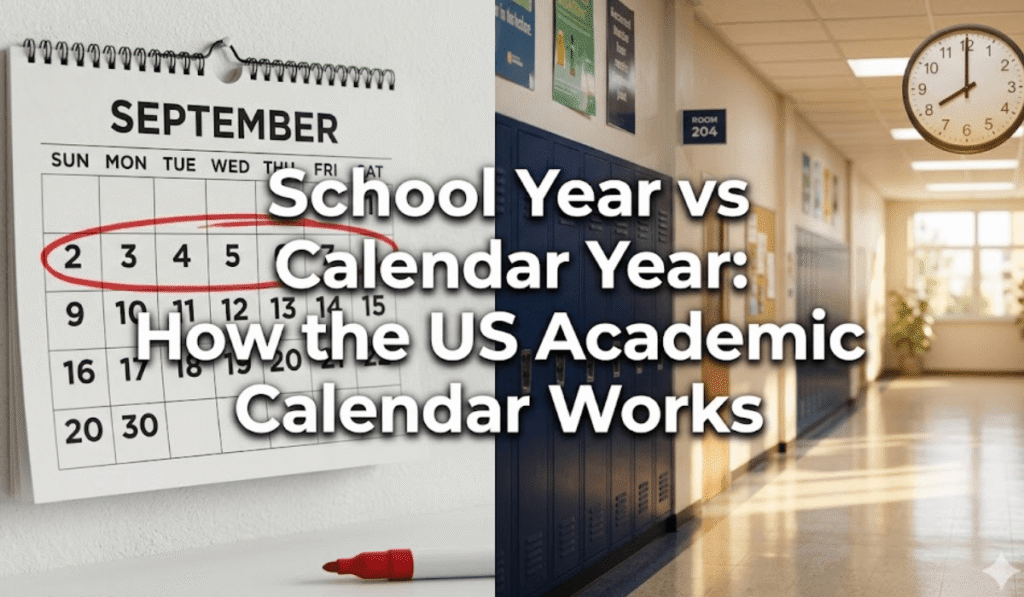
If you’ve ever filled out a form that asked for your child’s “school year” and found yourself momentarily confused — you’re not alone. The difference between a school year and a calendar year is one of those things that seems obvious until someone actually asks you to explain it. And in the United States, where academic calendars vary significantly from state to state and even district to district, the answer is more nuanced than most people expect.
This guide breaks down exactly how the US academic calendar works, why it’s structured the way it is, and what that means for families planning around the school year.
What Is a Calendar Year?
A calendar year is straightforward. It runs from January 1 through December 31 — 365 days in a standard year, 366 in a leap year. It’s the same system used for tax filings, fiscal planning, legal documents, and everyday life. When someone says “this year,” they almost always mean the calendar year.
Every person on the planet, regardless of where they live or what they do, operates within the same calendar year. It resets at midnight on New Year’s Eve, and it ends 12 months later.
What Is a School Year?
A school year — also called an academic year — is the annual period during which students attend school. In the United States, a school year does not align with the calendar year. Instead, it typically begins in late summer or early fall and ends the following spring or early summer.
For most US public school students, the school year runs from late August or early September through late May or June of the following calendar year. This means a single school year spans parts of two different calendar years.
For example, the 2024–2025 school year began in August or September 2024 and concluded in May or June 2025. When you see a school year written as two numbers separated by a dash — 2025–2026 — that notation reflects exactly this overlap.
Why Does the US School Year Start in Fall?
The fall start date is so deeply embedded in American culture that most people never stop to question it. But it has real historical roots.
The most commonly cited explanation is the agricultural calendar. In the 19th century, the United States was largely a rural, farming society. Children were needed at home during planting season in the spring and harvest season in the fall. Summer — not winter — was actually the least labor-intensive time on a farm, which is why summer became the long break rather than, say, a February recess.
Urban schools in the 1800s operated on a different schedule entirely — many ran nearly year-round. It was the standardization movement of the late 19th and early 20th centuries, driven by public health concerns, education reformers, and the desire for uniformity, that ultimately locked in the fall-to-spring model most Americans know today.
The long summer break became institutionalized for a combination of reasons: the agricultural legacy, concerns about heat in un-air-conditioned buildings, and the gradual merging of rural and urban school schedules into a single national norm.
How Many Days Are in a US School Year?
Federal law does not mandate a specific number of school days — that responsibility falls to individual states. However, most states require between 170 and 186 instructional days per school year.
Here’s how some states compare:
- Texas: 180 instructional days required
- California: 180 days minimum for most grade levels
- New York: 180 days required
- Ohio: 182 days required
- Colorado: 160 days (one of the lower state minimums)
- Kansas: 186 days (among the highest in the country)
Some states measure requirements in hours rather than days. For example, Oregon requires 900 instructional hours for elementary students and 990 hours for secondary students, allowing districts some flexibility in how they structure their calendars.
The 180-day standard is by far the most common benchmark. To put that in perspective, a standard calendar year has 261 weekdays — meaning US students attend school for roughly 69% of available weekdays each year.
When Does the School Year Start and End?
This varies more than most people realize. While the cultural image of “back to school” centers on the Tuesday after Labor Day, the reality is that start dates differ significantly by state and district.
Early starters (mid-to-late July or early August): States like Georgia, Texas, Florida, and Indiana often begin their school years in late July or early August. Some Georgia districts start as early as July 28.
Traditional starters (late August): Most of the Midwest and South falls into this category — Illinois, Missouri, Tennessee, and North Carolina typically begin in mid-to-late August.
Post-Labor Day starters: Several Northeastern states still follow the traditional post-Labor Day start. Michigan has a state law — the “Michigan Start After Labor Day” law — that requires most public schools to begin after Labor Day in order to support the state’s tourism economy.
On the end-date side, most schools finish between late May and mid-June, with later-starting schools typically finishing later into June.
Traditional Calendar vs. Year-Round Schooling
The majority of US public schools follow the traditional 10-month calendar — roughly September through June — with a long summer break of approximately 10 to 12 weeks.
However, a meaningful number of schools operate on a year-round calendar. Year-round schools still meet for the same number of instructional days (typically 180), but they distribute those days differently — replacing the long summer break with several shorter breaks spread throughout the year.
The most common year-round format is the 45-15 schedule: students attend school for 45 days, then take a 15-day break, cycling through this pattern four times across the year. Other formats include 60-20 and 90-30 schedules.
According to the National Center for Education Statistics, roughly 4 million US students attend year-round schools. These schools are more common in densely populated districts where school buildings operate on multi-track schedules to manage overcrowding.
Proponents of year-round schooling argue it reduces “summer learning loss” — the documented tendency for students, particularly in lower-income communities, to lose academic ground during the long summer break. Critics point to challenges with childcare planning, family vacations, and staff retention.
See also: 2026-2027 School Calendars
Key Dates That Structure the US School Year
Regardless of when a school year starts or ends, certain landmarks punctuate every academic calendar:
Fall Semester anchors:
- Labor Day (early September) — often coincides with the start of school or the first major holiday
- Columbus Day / Indigenous Peoples Day (second Monday in October) — a one-day break in many districts
- Veterans Day (November 11) — a one-day holiday observed by most districts
- Thanksgiving Break (week of the fourth Thursday in November) — typically Wednesday through Friday off, sometimes the full week
Winter Break: Usually 10 to 15 days spanning late December through early January, covering Christmas and New Year’s. Most districts resume classes in the first or second week of January.
Spring Semester anchors:
- Martin Luther King Jr. Day (third Monday in January) — observed by virtually all US public schools
- Presidents’ Day (third Monday in February) — widely observed
- Spring Break — typically one full week, usually in late March or April, often aligned with Easter week though not always
- Memorial Day (last Monday in May) — final major holiday of the school year
End of Year: Last day of school varies from mid-May to late June depending on the district. Graduation ceremonies for high school seniors typically occur in late May or June.
See also: What Happens on the First Day of School? What Parents and Students Should Expect
How the School Year Affects Families
Understanding the distinction between the school year and the calendar year has real, practical consequences for families:
Travel planning: Flights, hotels, and vacation packages cost significantly more during school breaks — particularly spring break and the summer months. Families who understand their district’s exact calendar can sometimes find savings by traveling just before or after peak break windows.
Childcare: Teacher workdays and professional development days — which fall within the school year but are not instructional days for students — can catch parents off guard. Knowing these dates in advance is essential for arranging backup childcare.
Tax and financial forms: Forms like the FAFSA (Free Application for Federal Student Aid) and many state financial aid applications reference “the school year” explicitly. Understanding that the 2025–2026 school year means fall 2025 through spring 2026 is important for completing these forms correctly.
Enrollment and residency: School enrollment cutoffs are tied to the academic year. Most states require children to turn five by a specific date — often September 1 — to enroll in kindergarten for that school year.
Final Thoughts
The US academic calendar is a product of history, geography, legislation, and local tradition — and it looks different depending on where in the country you live. Understanding the difference between the school year and the calendar year, knowing when your state typically starts and ends its academic year, and staying ahead of key dates like breaks and teacher workdays puts families in a much stronger position to plan effectively.
For exact dates for your specific district, always check your school’s official calendar — or find it quickly at PublicSchoolsCalendar.com.
FAQ
Q1. What is the difference between a school year and a calendar year?
A calendar year runs from January 1 to December 31. A school year — or academic year — typically runs from August or September of one calendar year through May or June of the next. A single school year spans parts of two different calendar years, which is why it’s written with a dash, such as 2025–2026.
Q2. How many days are in a US public school year?
Most US states require 180 instructional days per school year, though requirements range from 160 days (Colorado) to 186 days (Kansas). Some states set requirements in hours rather than days. The 180-day standard is the most common benchmark nationwide.
Q3. Why does the US school year start in fall and not January?
The fall start is rooted in the 19th-century agricultural calendar, where summer — not winter — was the least labor-intensive season for farming families. Urban and rural school schedules were later standardized into the fall-to-spring model during the late 1800s and early 1900s, and it has remained the national norm ever since.
Q4. What is year-round schooling and how is it different from a traditional school year?
Year-round schools meet for the same number of instructional days — typically 180 — but replace the long summer break with several shorter breaks spread throughout the year. The most common format is 45 days of school followed by 15 days off, repeated four times. Approximately 4 million US students currently attend year-round schools.
Q5. When does the 2025–2026 US school year start and end?
Most US public schools will begin the 2025–2026 school year between late July and early September 2025, depending on the state and district. The school year will end between late May and mid-June 2026. Exact dates vary by district — check your specific district’s official calendar for confirmed dates.

The PublicSchoolsCalendar.com Team compiles and verifies public school calendar data for districts across all 50 US states, drawing on official district websites and published family calendars to keep every page accurate and up to date.
Pingback: Richardson ISD School Calendar 2026-2027 | Printable PDF