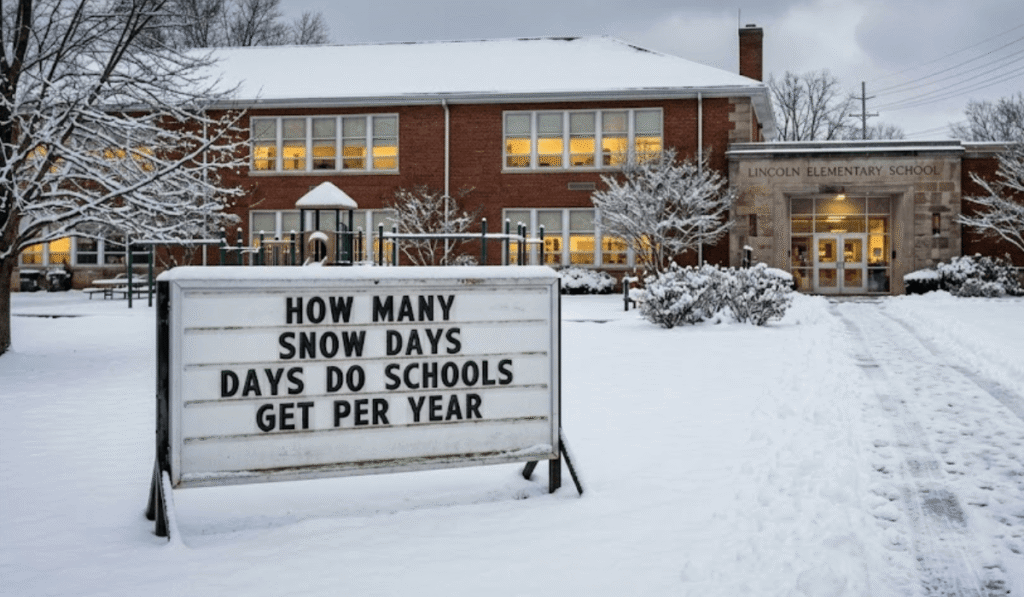
If you’ve ever watched your kids press their noses against the window on a stormy morning — desperately hoping for that school cancellation alert — you already know how much snow days matter to American families. But have you ever wondered how many snow days schools actually get each year, how districts decide when to call one, and what happens when they run out?
This guide breaks it all down with real numbers, state-by-state context, and everything parents and students need to know heading into the next school year.
The Short Answer: It Varies Wildly by State and District
There is no single national standard for snow days. The number of snow days a school gets per year depends entirely on geography, local weather patterns, state law, and individual district policy.
On average, US public schools experience somewhere between 1 and 6 snow days per school year — but that average masks enormous differences. A school district in central Alabama may go an entire decade without a single snow day. A district in Buffalo, New York or northern Minnesota might burn through 5 to 8 snow days before February even arrives.
The short version: where you live determines almost everything.
How Many Snow Days Are Built Into the School Calendar?
Most US school districts build a buffer of 3 to 5 emergency closure days directly into their academic calendar before the year begins. These pre-planned buffer days exist specifically to absorb weather closures without requiring makeup days at the end of the year.
Here is how it typically works in practice:
- The district sets a required number of instructional hours or days per state law
- A few extra days are padded into the calendar as weather buffers
- If the district uses fewer snow days than the buffer allows, students often get those days back as early release days or the school year ends slightly ahead of schedule
- If the district exceeds the buffer, makeup days are added — usually at the end of the year, during spring break, or on previously scheduled holidays
The size of the buffer varies by state and district. Northern states with consistent winter weather tend to build larger buffers. Southern states often build in just one or two days, if any.
See also: Burke County Public School District Calendar 2026-2027 | Printable PDF
Snow Days by Region: What the Data Shows
Looking at historical school closure data across US regions gives a much clearer picture than national averages.
Northeast and New England States like New York, Massachusetts, Pennsylvania, and Connecticut consistently see the highest snow day counts. Districts in upstate New York and northern New England routinely use 5 to 10 snow days per year. The 2022–23 school year saw several Massachusetts districts exhaust their full buffer and schedule makeup days due to back-to-back nor’easters in January and February.
Midwest Illinois, Ohio, Michigan, Wisconsin, and Minnesota all see significant winter weather. Districts in the Great Lakes region — particularly those near Lake Erie and Lake Michigan — face heavy lake-effect snowfall that can shut schools down multiple times per season. Average snow day usage in these states typically runs 3 to 7 days annually.
Mid-Atlantic States like Maryland, Virginia, and New Jersey sit in a tricky weather zone where winter storms are unpredictable but severe when they hit. Washington DC area districts have historically been among the most cautious in the country, sometimes closing schools for 2 to 3 inches of snow — a decision that draws criticism from northern neighbors but reflects regional road infrastructure and driver experience.
South and Southeast In states like Georgia, Tennessee, North Carolina, and Texas, even a forecast of light snow or ice can trigger school closures. Southern districts typically have little to no snow removal equipment, limited salting infrastructure, and drivers who rarely encounter icy conditions. A single winter storm can close schools for 2 to 3 days across an entire region. The infamous February 2021 winter storm in Texas forced school closures across the state for an entire week in many districts.
Western mountain-state districts in Colorado, Utah, and Idaho build snow days into their calendars routinely. Coastal districts in California, Oregon, and Washington rarely use them — though flooding and wildfire smoke have increasingly triggered weather-related closures in those states even without snow.
How Do Schools Decide to Cancel for Snow?
The decision to call a snow day doesn’t happen at 7 a.m. when someone looks out the window. Most districts follow a multi-step process that begins the night before.
Superintendents typically monitor weather forecasts from the National Weather Service starting 24 to 48 hours before a potential storm. Many districts have contracts with private meteorological services that provide hyperlocal forecasts specifically for school planning purposes.
Key factors considered before calling a closure include:
- Road conditions — reported by local highway departments and school bus drivers doing early morning route checks, often starting as early as 4 a.m
- Temperature and wind chill — extreme cold without snow can also trigger closures, particularly when wind chill falls below -20°F and walking to bus stops becomes dangerous
- Forecast reliability — superintendents must make the call before most buses depart, meaning the decision is often final by 5 to 6 a.m
- Staff availability — if a storm makes it unsafe for teachers and staff to travel, the school cannot operate safely even if roads are passable for students
- Building conditions — frozen pipes, heating system failures, or loss of power can force closures independent of outdoor conditions
The final call rests with the district superintendent, who carries full accountability for the decision — including the very public criticism that comes when a closure day turns out sunny by noon.
What Happens When Schools Run Out of Snow Days?
When a district exhausts its built-in weather buffer, state law determines what happens next.
Most states require districts to meet a minimum number of instructional days or hours per year — typically 175 to 180 days. If snow days push a district below that threshold, makeup days are required.
Common makeup day approaches include:
- Adding days to the end of the school year — the most common solution, typically pushing the last day of school back by the number of missed days
- Converting previously scheduled holidays — Presidents’ Day, spring break days, or Good Friday are sometimes reclaimed as makeup days
- Extending school hours — some states allow districts to make up missed time by adding minutes to remaining school days rather than full calendar days
- State waivers — during severe weather events affecting entire regions, state education departments sometimes grant blanket waivers excusing districts from makeup requirements. This happened widely during the COVID disruptions of 2020–21 and during major storm events in several states
Some states are more flexible than others. Michigan, for example, allows districts to count up to 6 hours of remote learning as a makeup day under its “COVID-era” distance learning policies that have since been codified into standard law.
See also: Average Number of School Days by State (2026 Data)
Are Snow Days Disappearing?
The rise of remote learning technology has changed the snow day conversation permanently. During the COVID-19 pandemic, districts across the country were forced to build out remote learning infrastructure almost overnight. Once that infrastructure existed, many districts decided to use it for weather days too.
As of the 2024–25 school year, a growing number of districts in states including Pennsylvania, Ohio, Virginia, and North Carolina now convert weather closure days into remote learning days rather than cancellations. Students log on from home, attend virtual classes, and the day counts toward the instructional requirement.
Not everyone is happy about it. Parents of younger children point out that remote learning days require adult supervision at home — which defeats part of the purpose of a snow day for working families. Teachers’ unions in several states have pushed back on mandatory remote teaching during weather events, citing safety and preparation concerns.
The traditional snow day — where everyone just gets the day off — is genuinely becoming less common in many districts, particularly at the middle and high school level.
Quick Reference: Snow Days by State Category
| Snow Day Usage | States |
|---|---|
| High (5–10 days/year) | New York, Massachusetts, Michigan, Wisconsin, Minnesota |
| Moderate (3–5 days/year) | Pennsylvania, Ohio, Illinois, Indiana, Colorado |
| Low (1–3 days/year) | Virginia, Maryland, New Jersey, Missouri, Kansas |
| Rare (0–1 days/year) | Georgia, Texas, Florida, California, Arizona |
Final Thoughts
Snow days are one of those small but genuinely meaningful parts of the American school year. They break the routine, create unexpected family memories, and remind everyone — parents, students, and teachers alike — that not everything runs on a schedule.
For parents trying to plan around them, the most practical advice is simple: check your district’s official calendar for the number of built-in weather buffer days, know your state’s makeup day policy, and bookmark your district’s closure notification system before winter arrives.
And if you live in Buffalo — maybe keep the hot chocolate stocked through April.
FAQs
Q1: How many snow days do most US schools get per year?
Most US public schools build 3 to 5 emergency weather days into their annual calendar. Average actual usage ranges from 1 to 6 days per year, with wide variation by state. Northern states like New York and Michigan regularly use their full buffer, while southern states may go entire years without a single closure.
Q2: What happens if a school uses more snow days than planned?
When a district exceeds its built-in buffer, it must make up the missed instructional time. The most common approach is adding days to the end of the school year. Districts can also reclaim holidays, extend daily school hours, or — in some states — apply for a state waiver excusing the missed days after severe regional weather events.
Q3: Can schools replace snow days with remote learning days?
Yes, and an increasing number of districts do. Many states now allow remote or virtual instruction days to count toward the minimum instructional requirement, meaning a weather closure no longer automatically means a lost school day. Whether this is an improvement depends heavily on the age of the students and whether parents can support at-home learning on short notice.
Q4: Why do southern states cancel school for just one inch of snow?
Southern districts lack the road treatment equipment, snowplows, and driver experience that northern states have built up over decades. A small amount of snow or ice on roads that are rarely treated creates genuinely dangerous conditions. The decision to close is based on infrastructure and safety reality, not weather severity alone.
Q5: Do snow days count toward summer vacation or push back the last day of school?
Only if a district exceeds its pre-built weather buffer. If a district uses fewer snow days than its buffer allows, the school year typically ends as scheduled — or occasionally a day or two early. It is only when closures exceed the buffer that the last day of school gets pushed back. Always check your district’s specific makeup day policy, as it varies by state and district.

The PublicSchoolsCalendar.com Team compiles and verifies public school calendar data for districts across all 50 US states, drawing on official district websites and published family calendars to keep every page accurate and up to date.