
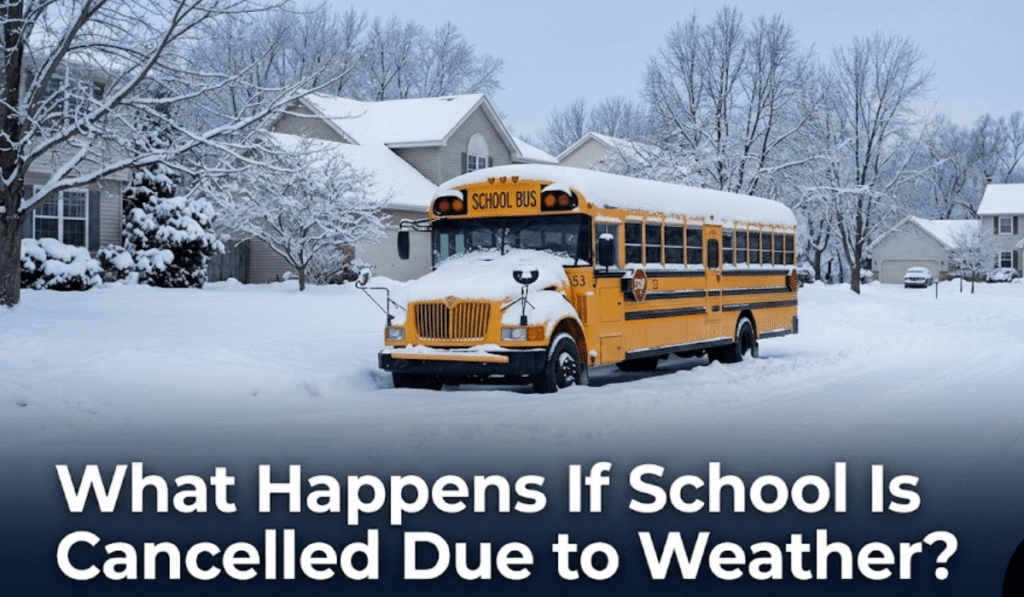
It’s 5:30 in the morning. You check your phone and there it is — school is cancelled due to weather. For kids, that notification means one thing: snow day. For parents, it usually means something else entirely: scrambling for childcare, rearranging work schedules, and wondering whether your child just lost a day of learning that needs to be made up later.
Weather cancellations are a normal, recurring part of the American school year. But what actually happens behind the scenes — how districts decide to close, what happens to the lost instructional time, and what the rules are — is something most families never fully understand until they’re living through a bad winter. Here’s a thorough, plain-language breakdown of everything that happens when school is cancelled due to weather.
How Schools Decide to Cancel
The decision to cancel school for weather is rarely made last-minute or lightly. Most districts follow a structured process, and the people responsible for that call are usually the superintendent and their operations team.
Factors that go into a closure decision typically include road conditions and whether school buses can safely travel, temperature and wind chill (especially relevant for students waiting at bus stops), whether sidewalks and parking lots can be cleared in time, weather forecasts from the National Weather Service, and communication from local emergency management agencies.
Most districts make closure decisions the night before or by 5 a.m. on the day in question, and announcements are pushed out through the district’s website, social media platforms, and notification apps like text and email alert systems.
The decision often comes down to the superintendent’s judgment call. Factors that seem minor — like whether freezing rain will fall at exactly the hour buses start running — can tip the scales.
The 180-Day Rule: Why It All Comes Down to Instructional Time
Here’s the number that drives almost every policy decision around weather cancellations: 180 days.
Thirty-one states plus the District of Columbia require at least 180 days of instruction per school year. Among the 37 states that identify a minimum number of days, 28 set it at 180. At the low end, Colorado requires 160 days, while Kansas mandates 186.
Some states measure instructional time in hours rather than days. Generally, the requirement is a minimum of the equivalent of 180 days of instruction at 4 to 6.5 hours per day, totaling between 720 and 1,170 total instructional hours depending on the state.
This minimum is not just an academic guideline — it’s tied directly to state funding. School districts must meet the 180-day requirement in order to be eligible for state funding. That is why every weather cancellation carries real consequences beyond just the inconvenience to families.
What Happens to the Lost Day?
When a school day is cancelled, districts have several options for making up that lost instructional time. Which option applies to your child’s school depends on your state’s laws, how many days have already been missed, and what the district built into the academic calendar ahead of time.
Built-In Buffer Days
Most districts don’t just plan for exactly 180 days — they plan for more, building in buffer days specifically for weather emergencies. Some districts build multiple emergency closure days directly into the academic calendar, where the first one or two closures require no makeup day at all. Only from the third closure onward are makeup days required.
Under state law in Virginia, public school districts must provide at least 180 instructional days, and most Richmond-area districts build makeup snow days into their calendars to use if needed.
Added Days at the End of the Year
The most common consequence families feel directly is a later last day of school. When a district exhausts its buffer days, it adds school days back onto the end of the calendar year — often converting scheduled vacation days or pushing the last day of school into late June.
For example, Battle Ground Public Schools in Washington state converted a previously scheduled day off in March into a regular school day and extended the school year by an additional day in June after two weather closures in February 2025.
In Iowa’s Johnston Community School District, specific weeks at the end of May and into early June are reserved on the academic calendar specifically as potential snow makeup days, with families advised not to make plans during those periods.
State Forgiveness Waivers
In extreme weather years, some districts accumulate so many closure days that they cannot realistically make them all up without running the school year into July. In those situations, districts can apply to the state for a waiver. New York’s state education commissioner is authorized to excuse up to five days for extraordinary circumstances — including extraordinarily adverse weather conditions, heating failures, fuel shortages, or power outages — if those days cannot be made up through scheduled vacation days.
The bar for receiving a state waiver is high, and it’s not automatic. A governor declaring a state of emergency does not automatically excuse districts from the 180-day requirement — they must still apply and receive approval.
The Rise of Virtual Snow Days
One of the biggest changes to hit weather cancellation policy in the last few years is the widespread adoption of virtual or remote learning days. Rather than cancelling school entirely, many districts now pivot to online instruction — and count that day toward the 180-day requirement.
As of the 2025–26 school year, four states including Arkansas and Massachusetts, plus the District of Columbia, prohibit counting remote learning toward instructional time, meaning makeup days are still required if weather closures push a district below the minimum. Twenty-three states limit how many remote days can count, requiring schools to make up any additional days beyond the cap. Limits are typically three to five days, but climb up to ten in several states including Virginia and Kentucky. Another twenty-three states allow district discretion on remote learning for inclement weather or do not appear to have a specific maximum policy.
In New York City, when a major storm hit in January 2026, Mayor Zohran Mamdani announced school buildings would be closed but that students would learn remotely — a decision affecting about 500,000 of the district’s 900,000 students.
Virtual snow days are not without critics. Research suggests that a handful of snow days have little effect on academic achievement, and some educators argue that moving instruction forward when attendance is low could actually be harmful. One fifth-grade teacher in Manhattan noted that about 70% of her students showed up for virtual instruction during the storm, and about half of those kept their cameras off — a far cry from a normal instructional day.
Maryland’s state department of education reversed course after allowing virtual snow days post-pandemic, issuing new guidelines that make it very difficult for districts to shift to virtual learning unless they have first used all of their designated in-person makeup days.
What This Means for Parents and Students
For families, a weather cancellation triggers a practical chain reaction. Here’s what to expect depending on how your district handles it:
If it’s the first or second closure of the year: In most districts with buffer days built in, nothing changes. The school year end date stays the same, and no makeup day is required.
If your district uses virtual snow days: Expect an email or app notification that school is closed in-person but classes will be held online. Your child will be expected to log in, complete assignments, and in many cases, be marked absent if they don’t.
If makeup days are added: Check for updated communications from your district. The most common changes are converting a previously scheduled day off into a school day, extending the end of the school year by one or more days, or in rare cases, scheduling a makeup day during spring break or winter recess.
If your state allows forgiveness waivers: In a severe winter, your district may apply for state permission to forgive some cancelled days entirely. This typically only comes into play after a truly exceptional winter with many closures.
See also: Why Do Different School Districts Start at Different Times?
What About School Staff and Hourly Workers?
Weather cancellations affect more than students. Days that are not made up directly affect hourly workers such as paraprofessionals and nutrition staff — those employees are not paid for days that school is not in session and are not made up. This is one of the reasons superintendents often push for makeup days even when not strictly required by state law — it protects the district’s lowest-paid workers from an unexpected loss of income.
Teachers and salaried staff are generally paid on annual contracts and do not lose income from a snow day. However, they do bear the burden of rescheduling content, adjusting lesson plans, and compressing curriculum when instructional days are lost.
How to Stay Informed About Closures and Makeup Days
The most reliable way to know what’s happening is to sign up directly for your district’s notification system. Most districts use text and email alert platforms to push closure announcements, and many update their websites and official social media accounts simultaneously.
When a makeup day is added to the calendar, that information is typically posted on the district’s academic calendar page on the official website. If your school uses a platform like Schoology, ParentSquare, or Remind, calendar changes are often pushed through those systems too.
If you use PublicSchoolsCalendar.com, we update district calendar pages whenever official changes are confirmed — so checking back after a weather event is a good habit during winter months.
The Bottom Line
When school is cancelled due to weather, the lost day doesn’t just disappear. Across most of the US, districts are required to account for that time — whether through built-in buffer days, added school days at the end of the year, virtual instruction, or in rare cases, a state waiver. The specific rules vary significantly by state, and there is no national policy dictating how many days or hours students must attend class — that decision is left to state lawmakers and school boards, which has led to significant variation depending on where a child attends school.
The best thing parents can do is know their district’s policy before winter hits, stay signed up for alert notifications, and keep an eye on the academic calendar toward the end of the year — especially if it’s been a rough winter for closures.
FAQs
Q1: Do students have to make up snow days?
It depends on your state and how many days have been cancelled. Most districts build one to two buffer days into the school year that require no makeup. Beyond those buffer days, state law typically requires the time to be made up — either through added days at the end of the year, virtual instruction, or a state waiver in extreme circumstances.
Q2: Can the school year be extended because of snow days?
Yes. Extending the school year by adding days in June is the most common way districts make up weather cancellations. Districts notify families through their official websites, app notifications, and email when end-of-year dates change. Always check your district’s academic calendar after a significant weather event.
Q3: What is a virtual snow day?
A virtual snow day is when a school district closes its buildings due to weather but continues instruction online. Students are expected to log in, attend classes or complete assigned work, and may be marked absent if they don’t participate. As of the 2025–26 school year, policies on whether virtual days count toward the required instructional minimum vary widely by state.
Q4: How many snow days are schools allowed before they have to make them up?
This varies by state and district. Many districts build in two to five weather closure days that require no makeup. After that, makeup is generally required. States like Kansas require a minimum of 186 school days, while others like Colorado set the floor at 160. Check your state’s Department of Education for the exact rules that apply to your district.
Q5: Does a snow day count as an absence for my child?
No. When school is officially cancelled district-wide due to weather, it is not counted as an absence for any student. However, if your district switches to a virtual snow day format and your child fails to log in or complete assigned work, some districts may mark that day as an absence — so it’s worth checking your school’s virtual attendance policy.

The PublicSchoolsCalendar.com Team compiles and verifies public school calendar data for districts across all 50 US states, drawing on official district websites and published family calendars to keep every page accurate and up to date.

Pingback: Boone County Schools Calendar 2026-2027 | Printable PDF